



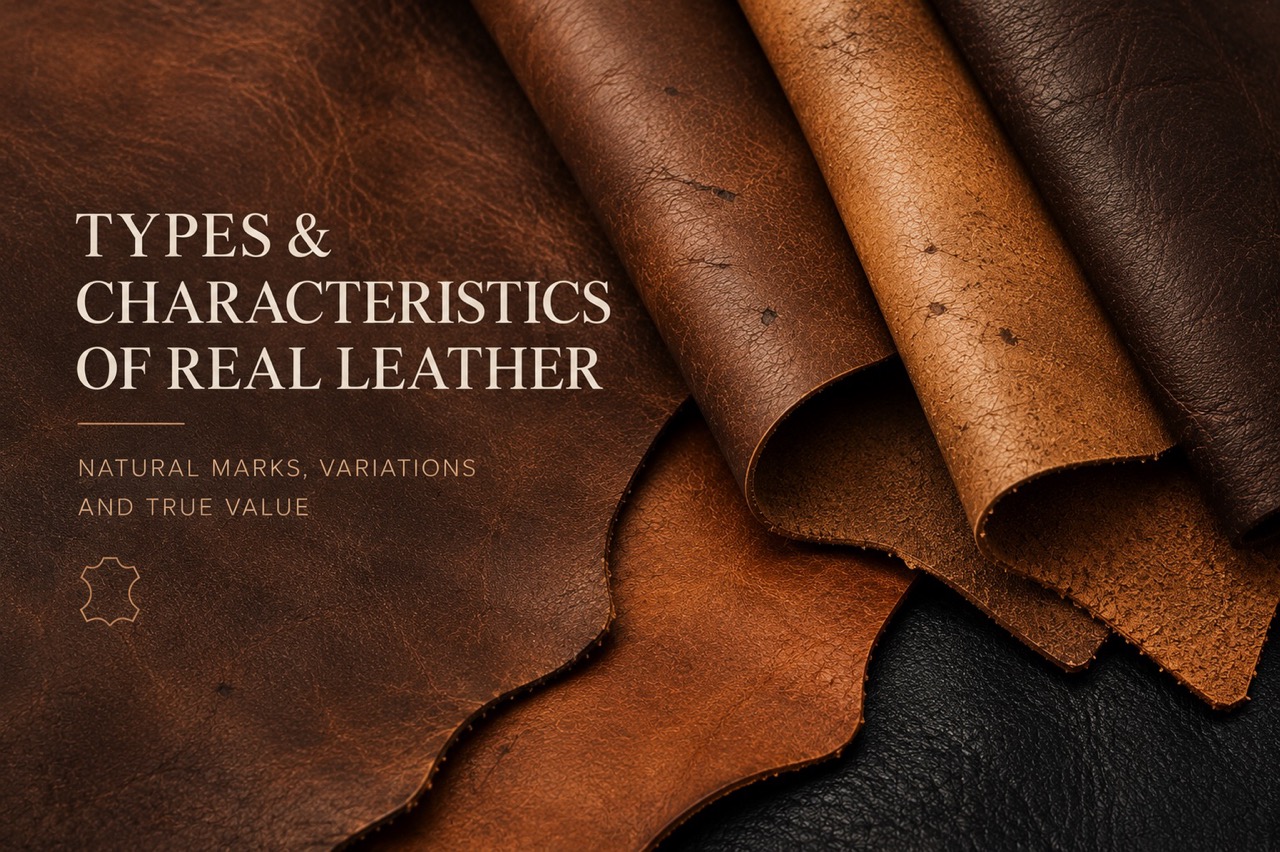
Types and Characteristics of Real Leather
Leather is one of the most commonly used materials in footwear, bags, and certain apparel categories. Yet in actual product development, “genuine leather” is often treated as if it were one simple material. In reality, leather comes in different grades, structures, and finishes, and those differences directly affect appearance, consistency, cost, and production decisions.
One of the biggest misunderstandings in development is the expectation that high-quality leather should look completely clean and flawless. That is not how natural material works. Leather is animal skin, which means some variation is normal from the start. Pores, small scars, insect bites, neck wrinkles, and differences in grain are all part of the material itself. As long as these do not affect strength or normal use, they are not defects in the usual sense.
This point becomes especially important when people talk about top-grain or full-grain leather. In general, the upper layer of the hide has a denser fiber structure and often offers better strength, feel, and natural character. But the more natural the leather is, the more visible those natural marks may also be. In other words, the same quality that gives leather depth and character is also what makes it less perfectly uniform than synthetic materials.
That is why leather with an extremely clean surface and highly even grain is usually more expensive. The issue is not simply the leather itself, but the selection process behind it. If the requirement is “natural leather, but with almost no visible marks and very strong consistency,” the usable area becomes smaller, material loss increases, and cost rises accordingly. This is not a matter of factories inflating prices. It is a direct result of tighter selection standards.
At the same time, not every product needs the same type of leather. Some leathers are chosen for a more natural and premium look. Others are selected because they offer a cleaner and more controlled surface. Corrected grain leather, embossed leather, suede, nubuck, and oiled leather all behave differently in both appearance and cost logic. Some are better for visual consistency. Some are better for texture and depth. Some age beautifully over time, while others are preferred because they look more stable from pair to pair.
For that reason, leather selection should not start with the question, “Which leather is the best?” It should start with a more practical question: “What kind of product are we actually trying to make?” If the goal is a natural, premium leather feel, some variation should be expected. If the goal is a cleaner and more uniform surface, then more controlled selection or additional finishing may be necessary, and that usually changes the cost.
This becomes even more sensitive in small-batch production. In smaller quantities, differences in leather surface and grain are often more noticeable. If the acceptable range is not aligned clearly at the beginning, misunderstandings can appear later. A factory may consider the material fully normal for genuine leather, while the brand may question why the pieces do not all look identical. In many cases, the real issue is not the quality of the leather itself, but the expectation placed on a natural material.
A more stable development process usually begins by confirming three things early: the visual direction of the product, the realistic budget range, and the required level of surface consistency. Once these points are clear, material selection becomes much easier and communication becomes more efficient. Without that alignment, it is very easy to ask for two conflicting things at the same time: natural leather character and synthetic-level uniformity.
The value of genuine leather has never been only about being natural. Its real value lies in texture, depth, touch, and the way it develops over time. And precisely because it is a natural material, a certain amount of grain variation and minor marks is not unusual but expected. For brands, the real goal should not be chasing “zero imperfection” at any cost. It should be finding the right balance between leather character, visual expectation, budget, and production feasibility.
Related Posts