





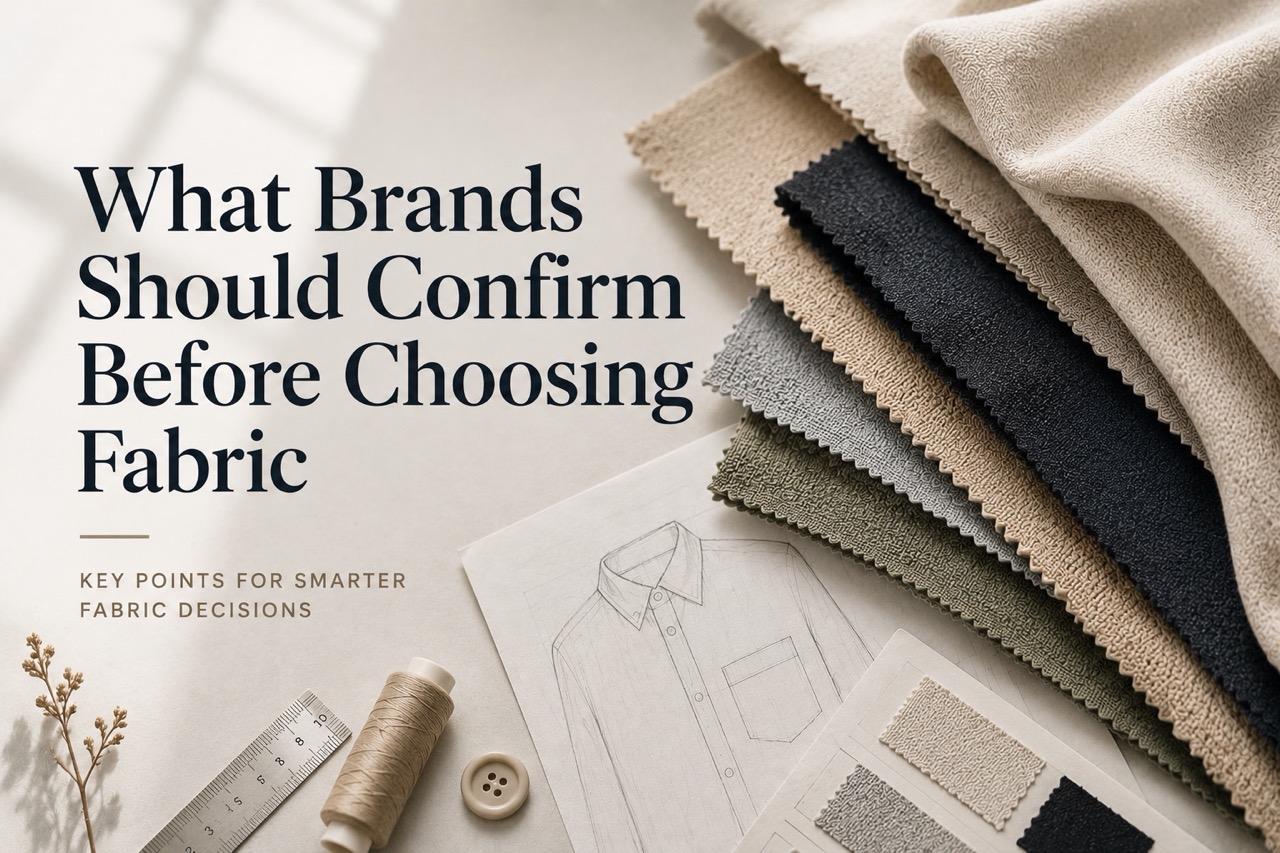
What Brands Should Confirm Before Choosing Fabric
In apparel development, fabric should not be selected based on appearance alone. A swatch may look good on the table, but that alone says very little about whether it is suitable for the actual product. Before locking any fabric, brands need to evaluate it as a production material — not simply as a visual choice.
The first thing to confirm is what kind of product the fabric is being used for. A shirt, a hoodie, a dress, and a pair of trousers do not ask the same thing from a material. Even when the design looks simple, the required balance between shape, hand feel, comfort, and sewing stability can be very different. That is why fabric selection should always begin with the product itself, not with the swatch alone.
The next point is fabric weight. Weight does not only affect thickness. It also affects drape, structure, sheerness, firmness, and how the garment sits on the wearer. A fabric that feels fine as a swatch may become too thin once made into a white shirt, too heavy once used in a layered style, or too weak to support the intended silhouette. In actual development, weight needs to be judged together with product type, season, and construction.
Construction matters just as much. Plain weave, twill, poplin, jersey, rib, fleece, interlock, and double-knit can create very different results, even when the surface impression seems close at first glance. Fabric construction affects stretch, recovery, surface stability, sewing behavior, and the overall character of the garment. If this is not understood early, a fabric may be chosen for its appearance while being completely wrong for the product in production terms.
Hand feel is another point that often creates misunderstanding. Brands sometimes choose a fabric because it feels soft, premium, or comfortable in hand, but softness alone does not mean the fabric will perform well in a finished garment. A soft fabric may collapse too much. A crisp fabric may feel too hard. A brushed surface may feel rich but may also create pilling concerns. A compact knit may look clean but may feel too heavy on the body. In other words, hand feel must always be judged together with silhouette and actual wear.
Shrinkage and post-wash behavior are also critical. Fabric should never be judged only in raw form. Washing, steaming, pressing, garment dyeing, or finishing can all change the material. Shrinkage, twisting after washing, surface change, and shifts in hand feel can affect fit and balance in a very direct way. This matters even more for products where body length, sleeve length, leg shape, or panel balance must stay consistent. If these points are not tested early, problems often appear after the first sample or during bulk production.
Sheerness and thickness also need to be checked against the design. A fabric that looks acceptable on the table may become too transparent in light colors, especially in shirts, dresses, or lighter-weight bottoms. On the other hand, a fabric that looks substantial in swatch form may become too bulky when used for collars, plackets, cuffs, binding, or gathered details. Fabric choice should always be checked against the actual pattern and sewing details, not only by touch.
Another key point is sewing compatibility. Some fabrics are easy to cut, stable to sew, and predictable in pressing. Others shift during cutting, stretch during sewing, fray heavily, mark easily under pressing, or behave inconsistently from panel to panel. These issues do not just affect workmanship. They affect production efficiency, size stability, reject risk, and ultimately cost. In OEM development, fabric choice is closely tied to whether the product can actually be produced in a stable and realistic way.
This is why cost should not be judged by fabric price alone. A cheaper material is not automatically a better option if it creates more wastage, more sewing difficulty, more instability, or more rework. At the same time, a higher-priced fabric may still be the better choice if it helps the product hold shape better, sew more cleanly, and achieve the intended look with less risk. Real cost has to be judged through the whole production process, not through the swatch price only.
These issues become even more visible in small-batch production. In small runs, every material decision shows more clearly in the final result. If the fabric direction is wrong, the sample will expose it quickly — through silhouette, comfort, sheerness, sewing problems, or wash behavior. That is why fabric selection should be aligned early with the product concept, target customer, intended selling price, and actual production method.
In practice, brands should confirm a few basic questions before choosing any fabric. What silhouette does the product need? What kind of touch and wearing feeling is expected? Does the design require structure or drape? Will the fabric be washed or finished? How much shrinkage is acceptable? Does the material work well with the construction details? Is it realistic for the target price? If these points are clear, fabric selection becomes much more accurate.
A good fabric is not simply the softest one, the most expensive one, or the one that looks best in a swatch book. The right fabric is the one that supports the design, works in production, performs well after sewing and finishing, and still fits the intended price structure. In many cases, the final quality of a garment is decided much earlier than people think — often at the fabric stage itself.
Related Posts